all search

Tel: +86-311-66695955, +86 18631137373
Factory Address: No.29-11 Jinyu Avenue, Zanhuang Economic Development Zone, Shijiazhuang City, Hebei Province, P.R.China
Office Address: 14th Floor, East Wing, Business Building 6, Xuhui Zhongrui Mansion, No.281 South Jianshe Avenue, Shijiazhuang City, Hebei Province
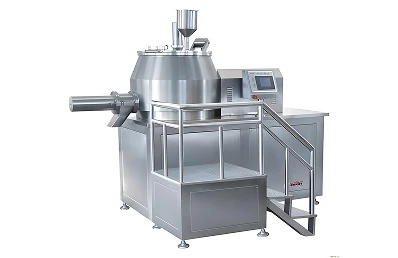
Wet granulationWidely used in the fields of pharmaceuticals, food, feed, and chemical powder processing, particle size directly affects material drying efficiency, flowability, tablet pressing effect, and finished product quality. Particles that are too fine can easily produce a large amount of fine powder, while particles that are too large can lead to uneven particle size and poor drying. The particle size is influenced by multiple process parameters, and operators need to clarify the logic of each parameter's action and systematically adjust and stabilize the particle size range. This article outlines the core adjustable parameters, adjustment ideas, and practical adjustment plans for wet granulation.
1、 Adhesive dosage and addition method (core factors affecting particle size)
Adhesive is a key raw material that promotes the aggregation of powder to form particles, and the total amount added directly determines the average particle size.
Insufficient addition of adhesive: insufficient wetting of the powder, difficult to agglomerate, high proportion of fine powder, difficult to form stable particles;
Excessive addition of adhesive: Excessive wetting of the powder can easily generate large wet lumps, resulting in larger particles that tend to stick to the wall and increase the difficulty of subsequent crushing.
Practical adjustment points: First fix other parameters and slightly increase or decrease the amount of adhesive used; Try to use uniform spray to add, avoid pouring in a large amount at one time, and prevent local excessive humidity from producing large lumps. Some formulas can adjust the adhesive concentration, and with the same amount of liquid added, increasing the concentration makes it easier to form larger particles.
2、 Adjustment of stirring blade speed
The stirring blade is responsible for powder mixing, driving wet materials to roll, and promoting material adhesion and agglomeration.
Low-speed operation of the stirring blade: the material flips gently, the probability of particle collision and adhesion is low, and the average particle size is relatively small;
High speed operation of the stirring blade: The material rolls violently, and the particles are continuously squeezed and bonded, making it easier to form large particles.
Attention: The speed should not be kept too high continuously. Excessive and intense friction will break the already formed particles, causing size differentiation and widening of particle size distribution. During the production process, segmented mixing mode can be set according to the target particle size, with low-speed mixing in the early stage and moderate acceleration in the forming stage.
3、 Cutting blade (whole blade) speed control
The cutting knife plays a role in breaking large lumps and adjusting particle morphology, and is an important component for regulating particle size distribution.
Cutting blade at low speed: weak crushing ability, unable to fully disperse large pieces of material, resulting in an increase in the proportion of large particles in the finished product;
Cutting knife at high speed: cutting wet materials, shredding large particles, reducing overall particle size, and increasing the proportion of fine powder.
Practical approach: If you want larger particles, reduce the cutting blade speed appropriately; Need small and uniform particles to increase the cutting blade speed. The mixing blade and cutting knife need to be matched and debugged. If a single set of speed is increased or decreased, it is easy to cause particle size fluctuations.
4、 Control of granulation time
The granulation time represents the duration of continuous agglomeration and shearing of materials in a wet state.
Short granulation time: insufficient material agglomeration, more fine powder, and smaller average particle size;
Extended granulation time: particles continue to collide and bond, and the particle size gradually increases; But if the time is too long, continuous shearing will cause particle breakage and polarization of particle size.
It is recommended to adopt a segmented timing method to record the standard granulation time from liquid addition to discharge, fix the process window, and reduce particle size differences between batches.
5、 Initial powder characteristics and loading capacity of materials
The loading capacity of the equipment silo will change the rolling state of the material. Insufficient loading results in the inability to form a stable material layer and poor agglomeration effect; If the loading capacity is too high, the mixing resistance will increase, and the material will not be fully flipped, which can easily lead to uneven particle size.
At the same time, there are differences in the fineness and water absorption of the powder raw materials. The raw material itself has a fine powder and strong water absorption, making it more difficult to form under the same process conditions. Therefore, it is necessary to moderately increase the amount of adhesive used; The raw material particles are coarse and have weak water absorption, making it easier to quickly form large particles. After changing the batch of raw materials, a small-scale trial should be conducted to explore the parameters first.
6、 Indirect effects caused by material temperature, environmental temperature and humidity
The high humidity in the environment makes it easy for the powder to absorb moisture in advance, and under the same amount of adhesive, it is more likely to form large lumps; When the air is dry, the surface moisture quickly dissipates, making it more difficult to form particles. Some heat sensitive and moisture absorbing materials require stable workshop temperature and humidity, eliminating environmental interference, and ensuring stable particle size during granulation.
7、 Selection of matching screen mesh (wet whole particle/dry whole particle auxiliary control particle size)
After wet discharge, a wet granulation sieve is configured, and the sieve aperture determines the upper limit of particles. Large aperture screen allows larger particles to pass through; The small aperture sieve blocks large pieces of material and forcibly crushes them.
Process idea: Relying on equipment operating parameters to control the basic particle size, and then cooperating with corresponding aperture whole particle sieves to intercept particle size and narrow down the particle size distribution range. Damaged or deformed screen mesh can reduce screening efficiency and cause mixing of small and large particles, requiring regular inspection and replacement.
8、 General regulation ideas for particle control (practical debugging sequence)
1. Prioritize fixing the formula, determine the type and concentration of adhesive, and adjust the variable based on the amount of adhesive added;
2. On the basis of appropriate wetting, match the stirring blade speed to establish the basic agglomeration conditions;
3. Fine tune the particle size by adjusting the cutting blade speed;
4. Determine a reasonable granulation time to avoid over granulation or insufficient granulation;
5. Finally, optimize the particle size distribution by combining the wet granulation sieve;
6. After determining the parameters, solidify them into standard operating procedures to reduce human operation fluctuations.
9、 Common granularity anomalies and solutions
1. Excessive fine powder and poor molding: moderately increase the amount of adhesive, slightly increase the stirring speed, and appropriately extend the granulation time;
2. There are many large wet lumps and large particles: reduce the total amount of adhesive, increase the rotating speed of the cutter, optimize the adhesive spray method, and avoid local over wetting;
3. There is a significant difference in particle size: check the compatibility between the mixing blade and the cutting knife to avoid long-term high-intensity shearing and ensure that the adhesive is evenly added;
4. Continuous wall sticking of materials: Reduce adhesive, optimize mixing speed, and check the cleanliness of the chamber.
Conclusion
Wet granulation machineThe particle size is the result of multiple factors, including adhesive, stirring blade speed, cutting blade speed, granulation time, loading capacity, and raw material characteristics. During the debugging process, it is important to avoid changing multiple parameters at once. It is recommended to conduct a single variable gradient test and gradually establish a stable process window.
Stable and controllable particle size can not only optimize the energy consumption of the drying process, but also improve the processing stability of downstream processes such as tablet pressing, coating, and mixing. Enterprises should establish complete process parameter records, form standardized SOPs, and ensure consistent particle indicators across different production batches.