all search

Tel: +86-311-66695955, +86 18631137373
Factory Address: No.29-11 Jinyu Avenue, Zanhuang Economic Development Zone, Shijiazhuang City, Hebei Province, P.R.China
Office Address: 14th Floor, East Wing, Business Building 6, Xuhui Zhongrui Mansion, No.281 South Jianshe Avenue, Shijiazhuang City, Hebei Province
IndustryMaterial pipelineIn the process of transporting cold and hot media and chemical materials, problems such as heat loss, medium cooling and condensation, pipeline corrosion, and energy consumption increase are prone to occur. Thermal insulation construction is a key supporting process for pipeline installation, which can effectively control temperature, save energy, prevent condensation and corrosion, and ensure the stability of the conveying medium. The standardized insulation construction process directly determines the operational efficiency and service life of the pipeline system. This article provides a detailed introduction to the standard construction process and core points of insulation for material pipelines.
1、 Pre construction preparation and base surface treatment
Before formal insulation construction, pre installation procedures such as pipeline installation, pressure testing, and non-destructive testing must be completed to confirm that the pipeline has no leaks and the welding quality meets the standards before entering the site for operation. At the same time, clean the base surface, remove dust, oil stains, rust, and water stains on the surface of the pipeline, and ensure that the pipe wall is dry and clean. For pipelines that require anti-corrosion coating, the anti-corrosion coating should be applied first. After the paint film is completely cured, insulation construction can be carried out to avoid impurities and rust affecting the bonding effect of the insulation layer, and to prevent problems such as hollowing and peeling.
2、 Selection and adaptation of insulation materials
The working conditions of material pipelines vary greatly, and insulation materials need to be matched according to the medium temperature and usage environment. Flexible insulation materials such as rubber insulation cotton, rock wool, and glass wool can be used for pipelines with materials at room temperature and low temperature; Aluminum silicate, polyurethane insulation pipe shell, and composite insulation board are preferred for high-temperature industrial material pipelines. The selection should be in accordance with the pipe diameter, working temperature, outdoor or indoor closed working conditions, ensuring that the material's thermal conductivity and temperature resistance level are suitable for the site requirements, and guaranteeing the insulation effect from the source.
3、 Main construction of pipeline insulation layer
The construction of insulation layer is the core process, mainly using two methods: pipe shell wrapping and roll wrapping. Priority should be given to using standardized insulation pipe shells for circular pipelines. The pipe shells should be pressed against the outer wall of the pipeline, aligned with the joint gaps, and fixed with special tape or strapping to ensure a tight fit between the pipe shell and the pipe wall, without gaps or looseness.
Large diameter pipelines and irregular fittings can be constructed using spiral wrapping with insulation rolls, and the overlap width should meet the requirements of the specifications, generally not less than 50mm, to prevent gap and temperature leakage. Irregular parts such as pipe bends, tees, valves, etc. need to be finely constructed by cutting, splicing, and overall wrapping. Large gaps and hanging hollows are strictly prohibited to avoid insulation dead corners.
4、 Construction of moisture-proof layer to prevent moisture failure
Add a moisture-proof layer for low-temperature pipelines and outdoor pipelines. After the completion of the insulation layer construction, evenly wrap the moisture-proof roll and waterproof film, seal and compact the overlap, and reinforce the port and joint positions. The moisture-proof layer should cover all insulation layers completely, without damage or leakage, effectively blocking the infiltration of moisture and rainwater from the air into the insulation layer, preventing the insulation material from absorbing water and moisture, leading to a decrease in insulation performance and pipeline condensation corrosion.
5、 Installation of outer protective layer to enhance the durability of protection
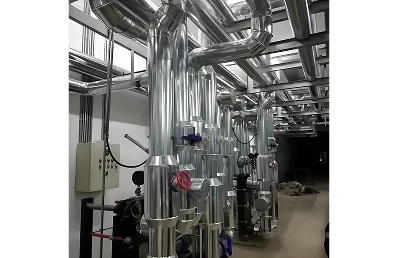
To protect the insulation structure from external damage and wind and rain erosion, an outer protective layer needs to be constructed. Indoor pipelines can be covered with color steel plates, galvanized iron sheets, and PVC protective shells; Outdoor and corrosive working condition pipelines should prioritize the use of weather resistant metal protective layers. The outer protective plate should be overlapped flat and firmly fixed, with even spacing between screws and buckles. The interface should be drained smoothly to avoid water and dust accumulation. The overall outer protective layer should have neat lines, no raised edges, and no damage, balancing protection and aesthetics.
6、 Detail Closing and Quality Acceptance
At the end of construction, sealing and sealing treatment should be carried out on pipeline ports, through wall positions, and equipment connections, using sealant to block gaps and prevent air and temperature leakage. After the overall construction is completed, the insulation layer should be checked for uniform thickness, tight fit, no hollowing, cracking, or detachment, complete moisture-proof layer, and firm and regular outer protective layer to ensure that the entire pipeline has no insulation dead corners and meets the industrial pipeline insulation construction specifications.
Summary
Material pipelineThe insulation construction follows the core process of base cleaning, material adaptation, dense insulation, moisture-proof protection, and external protection reinforcement. Fine control of each construction process can effectively reduce energy consumption and prevent condensation corrosion of pipelines, while also extending the service life of pipelines and insulation systems, ensuring stable and safe operation of industrial material transportation.